What a Kalshi 15 Minute BTC Contract Is, and What Fair Value Means
New to prediction markets? Start here. How a Kalshi 15 minute BTC contract pays out, why price is a probability, and what fair value and edge mean on hyhy.app.
By HYHY.APP ·
New to prediction markets? Start here. This is the foundation for everything else on hyhy.app.
What is a Kalshi 15 minute BTC contract?
Kalshi lists a new Bitcoin contract every 15 minutes. It asks one yes/no question, roughly: will BTC finish this 15 minute window above where it started?
There are two sides:
- YES pays $1.00 if the answer is yes
- NO pays $1.00 if the answer is no
The losing side pays $0. That is the whole payoff. There is no leverage and no liquidation, and the most you can lose is what you paid.
Why is price a probability?
Contracts trade between 1¢ and 99¢. Because a winning contract pays 100¢, the price doubles as the market's estimate of the probability.
- YES trading at 47¢ means the market implies about a 47% chance of YES
- NO trades at roughly the other side, so about 53¢
If you buy YES at 47¢, you risk 47¢ to win 53¢. The market is saying those odds are fair.
What is fair value?
Fair value is my model's own estimate of what the contract should be worth. It uses inputs like the current BTC price, the time left in the window, and volatility from the options market. I covered the details in Pricing Kalshi 15 Minute BTC Markets with the Vol Smile.
If the model says YES is worth 54¢, that is a claim that the true chance of YES is about 54%.
What is edge?
Edge is the gap between the model and the market:
Edge = model fair value − market price
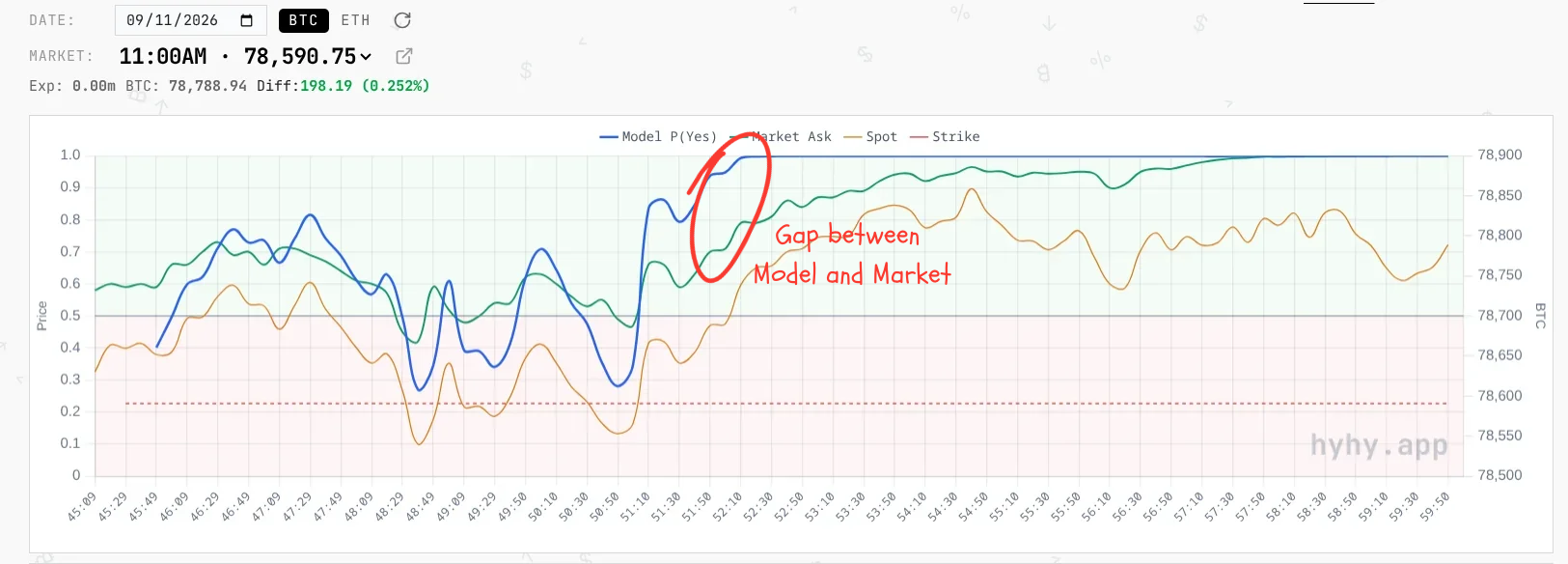
Using the example below, the model says 99¢ and the market says 80¢, so the edge is +19¢. In plain terms, the model estimates this contract is underpriced by 19¢. That is the number you see ticking on the chart.
A worked example
Say you buy one YES contract at 80¢ and the model's 99% estimate is right.
- If YES wins (99% of the time), you collect 100¢ and profit 20¢
- If YES loses (1% of the time), you lose 80¢
Average outcome per contract:
(0.99 × 20¢) − (0.01 × 80¢) = 19.8¢ − 0.8¢ = +19¢
That 19¢ matches the edge. It is the average profit per contract over many trades, assuming the model is correct and before fees.
What edge does not tell you
This is where most newcomers get tripped up.
- It is an average, not a prediction. In this example you still lose 1% of the time. A single trade tells you almost nothing.
- The model can be wrong. Edge only exists if the model's probability is closer to the truth than the market's. Most of what I write on this site is about testing exactly that.
- Fees and spread reduce it. A 19¢ edge can shrink a lot after fees and crossing the bid/ask spread.
- Short windows are noisy. A 15 minute contract can swing on one large order or a sudden move in BTC.
How does this show up on the chart?
On the chart, fair value and the market price are plotted together, and the edge shows as an annotation. You can also set your own signals, for example "highlight when edge is above 5¢." Think of signals as a way to mark moments you want to look at, not as instructions to trade.
Where to go next
- Making a Trade out of the Model
- The Market Always Bites Back
- Adding Flip Probability to 15 Minute BTC/ETH Pricing
Data and model output on hyhy.app are informational only and not investment advice. Models can be wrong. Not affiliated with Kalshi.