Adding Flip Probability to 15 Minute BTC/ETH Pricing
Part 4 of the hyhy.app series. Why entries and exits should account for the chance that price touches the strike again before expiry, and how a barrier option approach fills that gap.
By HYHY.APP ·
What was missing from the model?
I have already shared how I price the 15 minute BTC and ETH prediction markets as short-term options, with adjustments for the microstructure of these contracts. A recent discussion with a user of hyhy.app brought something to my attention. An execution entry and exit should not rely on edge alone. It should also account for the likelihood of price approaching the strike again before expiry.
How do you model the chance of a flip?
That got me thinking about how to model this using the same anchor, leveraging the volatility data I already use to price the terminal outcome. To model the probability of price hitting the strike from where it currently stands, I needed to handle two scenarios: price below the strike going above, and price above the strike going below.
Tackling one scenario first, I quickly realized this prices out as a touch (barrier) option. We are simply modeling the probability of price touching the strike within the remaining time to expiry. In other words, the probability of the Yes or No side flipping.

How did I make it usable?
To make this probability useful for an execution decision, I needed a live, point-in-time calculation. Luckily, the literature on barrier option pricing is widely available, and the main market data input is the same volatility feed I already run. I tested the base approach across many live sessions and added tuning to better fit what I was actually seeing. Spinning up a separate pipeline alongside the terminal outcome calculation turned out to be a quick exercise.
When does it matter most?
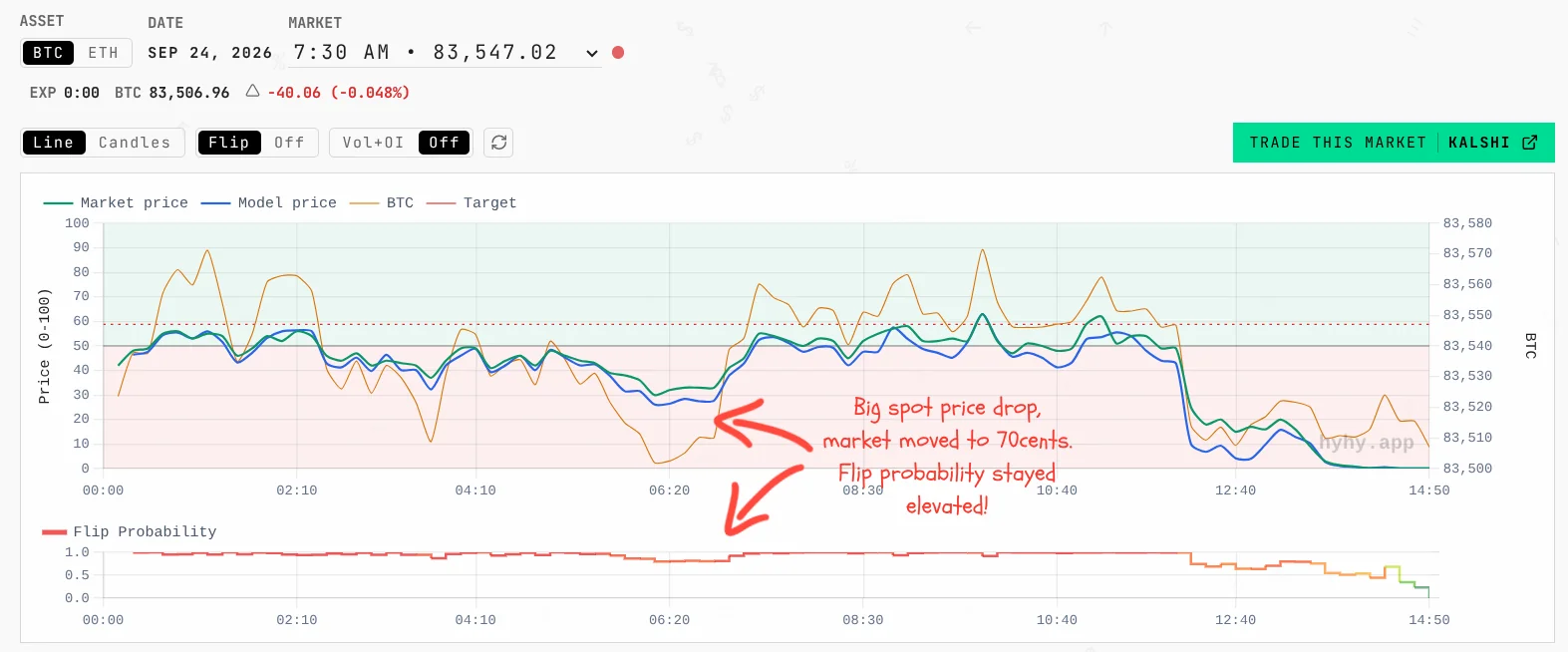
It turns out to be most valuable in exactly the situation you would assume is safest. That is when the market shows high confidence in the terminal outcome, but touch probability is also elevated.
That is a real warning sign. It means price still has a live path back through the strike before expiry, even while the market and the model both like where it is heading. The net effect is fewer entries in choppy approach-to-strike conditions, even when terminal confidence looks strong.
Watching your back is just as important as knowing your destination.