Kalshi Averages 60 BTC Prices at Settlement. Here's Why It Barely Matters Until It Does.
How Kalshi's 60-observation BTC settlement mechanism works, why it differs from terminal-price option probabilities, and how hyhy accounts for the difference during the final minute.
By HYHY.APP ·
How Kalshi Settles 15-Minute BTC Markets, and Why It Barely Matters Until It Does
The question
Kalshi's rules for these markets include this note:
The price used to determine this market is based on CF Benchmarks' corresponding Real Time Index (RTI). At the last minute before expiration, 60 RTI prices are collected. The official and final value is the average of these prices.
A common reaction is that averaging must invalidate any option-based pricing model. But is that actually true?
Let's look at what the settlement rule changes, when it matters, and how hyhy accounts for it.
Spot at expiry vs. the average of 60 prints
A standard option smile gives us a probability distribution for where BTC will be at a specific point in time.
Kalshi doesn't settle on the last BTC price before expiration. It takes 60 price observations during the final minute and averages them.
In practice, this makes little difference when BTC is comfortably above or below the target. If BTC is $300 above the target with a minute left, a few small price fluctuations aren't likely to change the outcome.
When BTC is sitting right on the strike, things get more interesting. BTC might trade above the strike, dip below it, and move back up several times during that final minute. The last price alone doesn't tell us where the contract will settle. What matters is the average of all 60 observations.
Trading in this high-gamma regime is almost like trading multiple coin tosses at the same time. Small price movements can have an outsized impact on the contract's probability, and the final average determines which side wins.
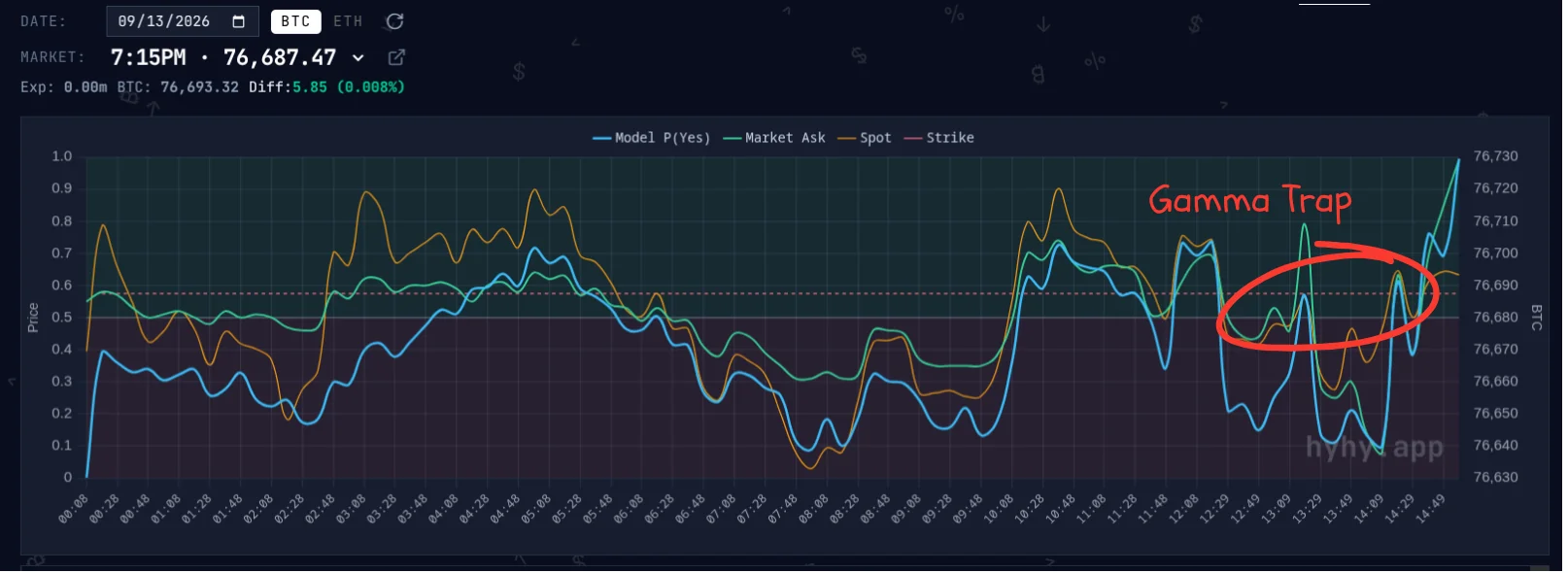
That's where the option smile and Kalshi's settlement mechanism can start telling slightly different stories.
What the option smile can and can't see
Hyhy derives its fair value from the options market implied smile.
The smile provides a market-implied probability distribution for BTC's terminal price. It is a useful way to estimate the probability of finishing above or below a given target.
However, it does not directly model Kalshi's specific 60-observation settlement mechanism.
That introduces a small but important settlement-specific modeling difference.
For most of the contract's life, the difference is unlikely to have a material impact on the estimated probability. But during the final minute, particularly when BTC is near the target, the difference can become significant.
This is where the difference between the smile's terminal-price probability and Kalshi's actual settlement probability becomes most relevant.
How hyhy accounts for this
Hyhy uses the option smile as its primary source of fair value throughout the first 14 minutes.
Only during the final 60 seconds does hyhy gradually blend its smile-derived fair value toward the live Kalshi market price.
The reasoning is straightforward: the Kalshi order book provides an independent market-based reference that reflects trading activity around the actual contract and its settlement mechanics.
The option smile provides the probability derived from the options market, while the Kalshi order book provides a market-based reference for the actual contract. During the final minute, using both helps account for the settlement-specific uncertainty.
Blending the two is a way to account for increasing uncertainty in the model as expiration approaches.
When the Model Finds a Mispricing, and When It Doesn't
But there's another aspect of model behavior worth paying attention to: what happens when the model doesn't identify a mispricing.
If the option smile doesn't indicate a meaningful discrepancy with the Kalshi market during the first 14 minutes, that's not necessarily a missed opportunity. It is still a positive result.
A stable model that doesn't manufacture mispricing signals or overreact to short-term price movements is doing something important: it's demonstrating discipline.
Of course, identifying mispricings is only half the equation. Whether those probabilities are accurate is something that ultimately has to be measured against realized outcomes over time. But knowing when not to call something a mispricing is an equally important part of building a reliable model.
In fact, the absence of a signal can be just as informative as the presence of one. We want a model that identifies genuine discrepancies when they exist, but remains appropriately calibrated when they don't.
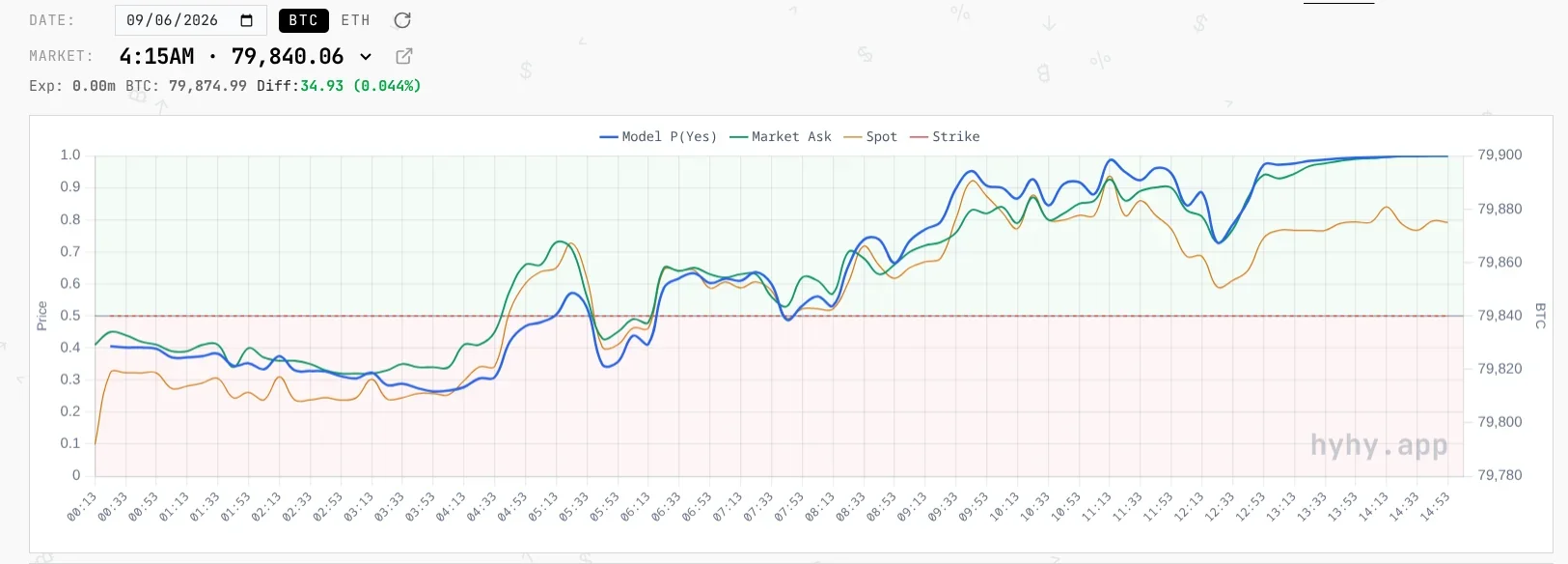
That's part of the smell test. A model that constantly finds opportunities is worth questioning. A model that can also sit still when the market and the option smile agree is much more credible.
Data and model output on hyhy.app are informational only and not investment advice. Models can be wrong. Not affiliated with Kalshi.