An entry gate that surprised me
How I structure entries on Kalshi's 15-minute BTC market. A conviction count and a few simple gates sit on top of a volatility-based model price, including a cheap moving average check that guards against price spikes.
By HYHY.APP ·
In the past, I discussed how I price 15-min BTC as an option. I've simplified my entry explanation to just watching the edge the model shows. I'd like to go into more detail on how I approach entry.
The model I run prices the contract from the observed smile, using market information from the option chain, adjusted for trend, slope, volume and more. The thesis is that option pricing is forward-looking, while traditional indicators often lag. But a good price is not the same as a good entry, so I've structured entry as a pipeline of conviction and gates.
Conviction
Here is a conviction example that I tested.
As the model and market tick, once the model leads the market by a minimum gap, I start counting up. When the lead begins to conflict, I reduce the count. I had this set up asymmetrically, for example +1 up and -2 down. Conviction passes when the count rises above a threshold (a time-based linear function).
Gates
Conviction alone isn't enough. On gates, among many, I look at things like moneyness and time to maturity. A tight moneyness is too risky, and entering early in the session leaves my position exposed for a long period.
The gate that surprised me: a cheap watch on trend
One gate came as an unintuitive surprise: the simple moving average. I had built my whole thesis on the idea that a vol-based price leads the market and that traditional indicators lag. The model already adjusts for trend and reacts to spikes through volatility, so why add an SMA?
Because it's cheap, and because it reads the move differently. The trend adjustment is one input among several, so in a sharp move it may not surface in time, or it may be overshadowed by the other inputs. The SMA is a plain average of recent prices with nothing to model. When spot is far from it, I treat that as a reason to wait. It isn't there to predict direction or to correct the model. It's a cheap second look that costs almost nothing to run.
Here's the case it covers. A sudden spike pushes spot far from the strike. The model adjusts, but a sharp move can still open up a lead over the market that doesn't hold, and conviction starts counting on it. The SMA barely moves during a spike, so it stays anchored near where price has actually been trading. A simple gate requiring spot to stay within a certain range of the SMA catches this. If spot has jumped away from the SMA, I wait.
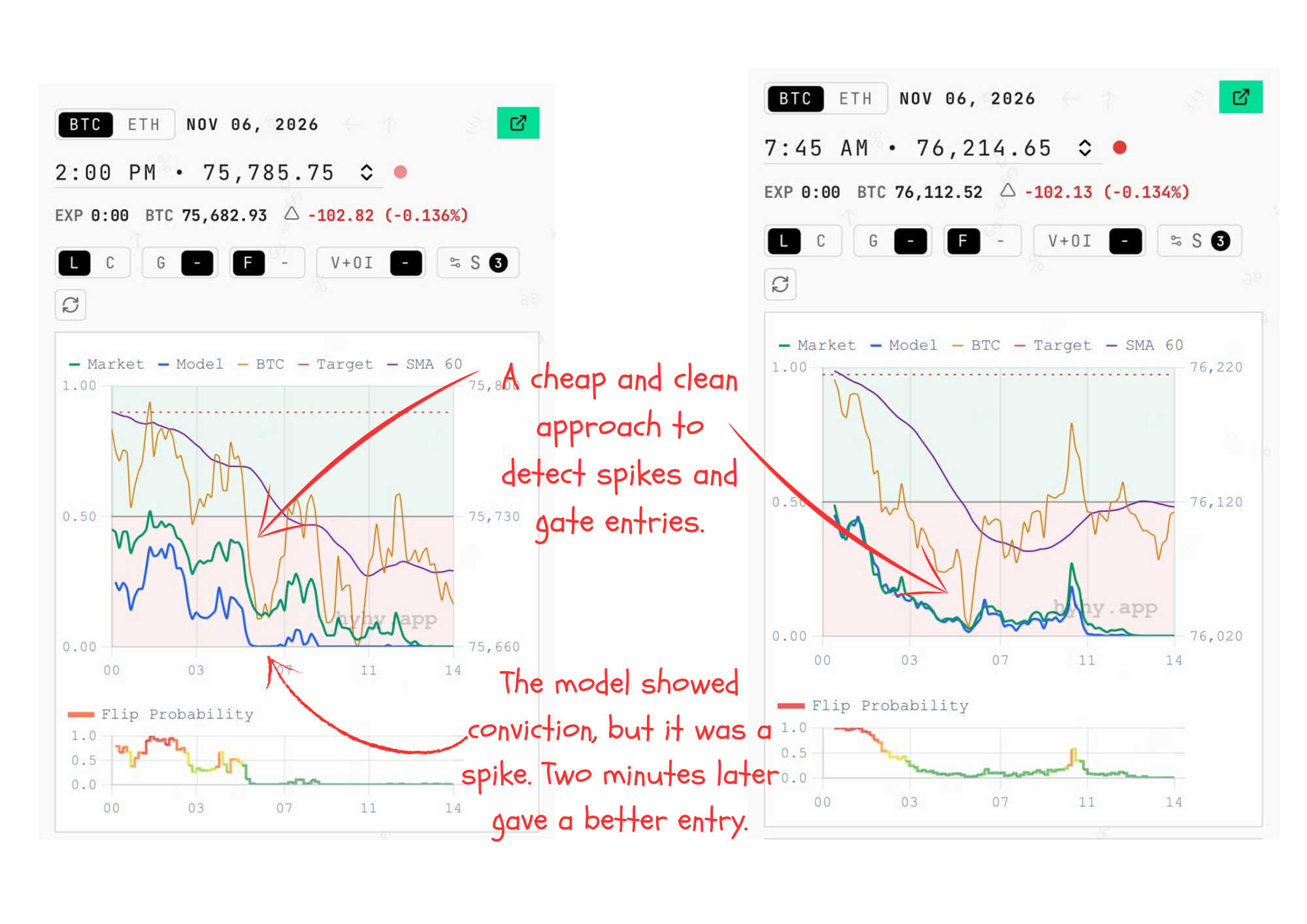
The model still makes the call. The SMA is a cheap watch on top of it. It has saved me from bad entries and reversals many times. It was a reminder that an idea I'd dismissed still had something to teach me.